Key Visuals
2025.04 – 2025.07
Coursework-based experimental HRI study at Technische Universität Berlin on how visible eyes and belief cues shape Level-1 visual perspective taking toward humanoid robots.
As social robots become more common, it is critical to understand when humans spontaneously adopt a robot's perspective. Prior findings suggested humanoid form may be enough, but appearance-based and belief-based cues were often confounded. This project disentangled those factors by testing whether visible eyes and explicit beliefs about visual capacity independently trigger VPT1.
I contributed to study framing and HRI experiment design, including condition definition around robot visual morphology (eyes/no eyes) and belief manipulation (can see/cannot see), as well as interpretation of altercentric intrusion outcomes for social robot design implications.
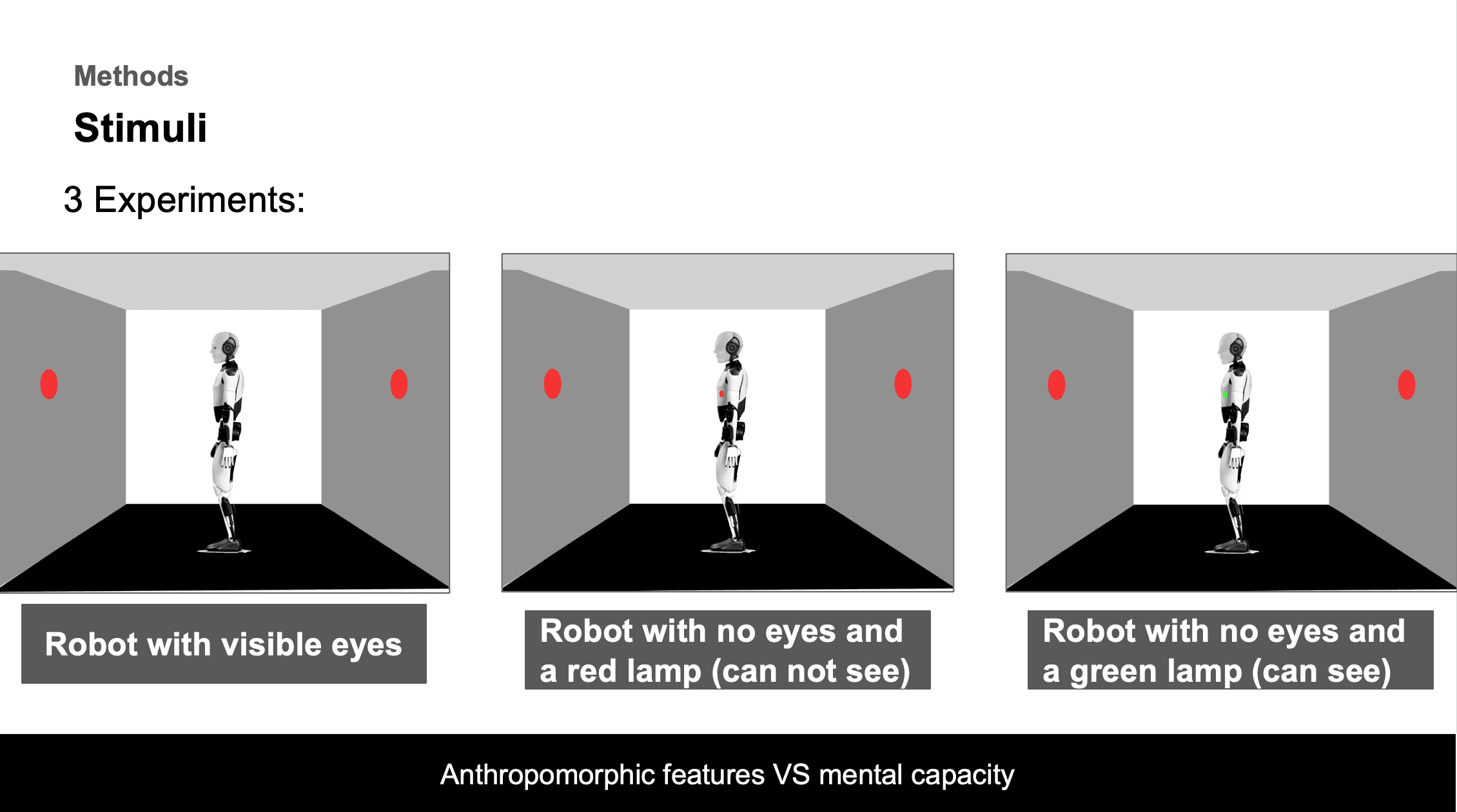
We conducted a three-experiment dot-matching paradigm based on VPT1 tasks. Experiment 1 replicated prior work with a humanoid robot with visible eyes. Experiment 2 removed visible eyes and introduced a red lamp cue indicating the robot could not see. Experiment 3 used an eye-less robot with a green lamp and instruction that it could see. Reaction time and accuracy were analyzed (mixed ANOVA + follow-up tests) to evaluate altercentric and egocentric intrusion effects.
Altercentric intrusion was replicated in the visible-eyes condition but disappeared when eyes were removed, indicating that eye-like visual morphology is a critical cue for spontaneous VPT1 in this setup. Accuracy showed a general inconsistency cost, while reaction time was the more sensitive VPT signal. Experiment 3 remained inconclusive due to insufficient sample size, motivating follow-up studies with stronger belief manipulations and larger samples.